The next CEO of Stack Overflow

Big news! We’re looking for a new CEO for Stack Overflow. I’m stepping out of the day-to-day and up to the role of Chairman of the Board.

Stack Overflow has been around for more than a decade. As I look back, it’s really amazing how far it has come.  

Only six months after we had launched Stack Overflow, my co-founder Jeff Atwood and I were invited to speak at a Microsoft conference for developers in Las Vegas. We were there, I think, to demonstrate that you could use their latest ASP.NET MVC technology on a real website without too much of a disaster. (In fact .NET has been a huge, unmitigated success for us, but you kids go ahead and have fun with whatever platform you want mkay? They’re all great, or, at least, above-average).

It was a giant conference, held at the Venetian Hotel. This hotel was so big that other hotels stay there when they go on vacation. The main ballroom was the size of, approximately, Ireland. I later learned there were 5,000 developers in that room.

I thought it would be a fun thing to ask the developers in the room how many of them had visited Stack Overflow. As I remember, Jeff was very much against this idea. “Joel,” he said, “That is going to be embarrassing and humiliating. Nobody is going to raise their hand.”

Well, I asked it anyway. And we were both surprised to see about one-third of the hands go up. We were really making an impact! That felt really good.

Anyway, I tried that trick again whenever I spoke to a large audience. It doesn’t work anymore. Today, audiences just laugh. It’s like asking, “Does anyone use gravity? Raise your hand if you use gravity.”

Where are we at after 11 years? Practically every developer in the world uses Stack Overflow. Including the Stack Exchange network of 174 sites, we have over 100 million monthly visitors. Every month, over 125,000 wonderful people write answers. According to Alexa, stackoverflow.com is one of the top 50 websites in the world. (That’s without even counting the Stack Exchange network, which is almost as big.) And every time I see a developer write code, they’ve got Stack Overflow open in one of their browser windows. Oh and—hey!—we do not make you sign up or pay to see the answers.

The company has been growing, too. Today we are profitable. We have almost 300 amazing employees worldwide and booked $70m in revenue last year. We have talent, advertising, and software products. The SaaS products (Stack Overflow for Teams and Enterprise) are growing at 200% a year. That speaks to the fact that we’ve recruited an incredibly talented team that has produced such fantastic results.

But, we have a lot of work ahead of us, and it’s going to take a different type of leader to get us through that work.

The type of people Stack Overflow serves has changed, and now, as a part of the developer ecosystem, we have a responsibility to create an online community that is far more diverse, inclusive, and welcoming of newcomers.

In the decade or so since Stack Overflow started, the number of people employed as software developers grew by 64% in the US alone. The field is going to keep growing everywhere in the world, and the demand for great software developers far outstrips supply. So a big challenge for Stack Overflow is welcoming those new developers into the fold. As I’ve written:

One thing I’m very concerned about, as we try to educate the next generation of developers, and, importantly, get more diversity and inclusiveness in that new generation, is what obstacles we’re putting up for people as they try to learn programming. In many ways Stack Overflow’s specific rules for what is permitted and what is not are obstacles, but an even bigger problem is rudeness, snark, or condescension that newcomers often see.

I care a lot about this. Being a developer gives you an unparalleled opportunity to write the script for the future. All the flak that Stack Overflow throws in the face of newbies trying to become developers is actively harmful to people, to society, and to Stack Overflow itself, by driving away potential future contributors. And programming is hard enough; we should see our mission as making it easier.

The world has started taking a closer look at tech, and understanding that software and the internet are not just tools; they are shaping the future of society. Big tech companies are struggling with their place in the world. Stack Overflow is situated at the right place to be influential in how that future develops, and that is going to take a new type of leader.

new dog, too

It will not be easy to find a CEO who is the right person to lead that mission. We will, no doubt, hire one of those fancy executive headhunters to help us in the search. But, hey, this is Stack Overflow. If there’s one thing I have learned by now, it’s that there’s always someone in the community who can answer the questions I can’t.

So we decided to put this announcement out there in hopes of finding great candidates that might have been under the radar. We’re especially focused on identifying candidates from under-represented groups, and making sure that every candidate we consider is deeply committed to making our company and community more welcoming, diverse, and inclusive.

Over the years, Fog Creek Software created several incredible hits and many wonderful memories along the way. It is great to watch Trello (under Michael Pryor) and Glitch (under Anil Dash) growing into enormously valuable, successful, and influential products with dedicated leaders who took these products much further than I ever could have, and personally I’m excited to see where Stack Overflow can go and turn my attention to the next thing.

Announcing Stack Overflow for Teams

Hey, we have a new thing for you today!

Today’s new thing is called Stack Overflow for Teams. It lets you set up a private place on Stack Overflow where you can ask questions that will only be visible to members of your team, company, or organization. It is a paid service, but it’s not expensive.

I meet people who use Stack Overflow every single day, but a lot of them tell me they have never needed to post their own question. “All the questions are already answered!” they say. Mission accomplished, I guess!

Still, when I think about what questions developers have every day, only the ones that have to do with public stuff can be asked on Stack Overflow. Maybe you don’t have a question about Python or Android… maybe you want to ask something about your team’s own code base!

That’s the idea behind Stack Overflow Teams.

Helicopters

Quick background: every development team since the beginning of time has been trying to figure out how to get institutional knowledge out of people’s heads and into written, searchable form where everyone can find it. Like new members of the team. And old members of the team working on new parts of the code. And people who forgot what they did three years ago and now have questions about their own code.

For a while developers thought wikis might be the solution. Anyone who has used a wiki for this purpose has probably discovered that not very much knowledge actually makes it into the wiki, and what does is not particularly useful, doesn’t get updated, and honestly it just feels like a bunch of homework to write a bunch of wiki documentation about your code when you don’t know if it will ever help anyone.

Another solution being sold today is the idea of having some kind of online IRC-style chat rooms, and hoping that by searching those chat archives, you can find “institutional knowledge.” Ha ha ha! Even if that works, all you really find is the history of some conversation people had. It might have clues but it’s not knowledge.

But you know what does work? A Q&A system. Like Stack Overflow.

Why? Because unlike wikis, you don’t write documentation in the hopes that one day it might help someone. You answer questions that are going to help someone immediately. And you can stop answering the minute you get the green checkmark that shows that you solved their problem.

And unlike chatrooms, searching actually works. It finds you a question and its answers, not a conversation-captured-in-amber.

This is why Stack Overflow worked so much better on the public internet than the previous generation of discussion forums, and we think that it will work for all the same reasons with teams’ proprietary questions and answers.

When you join a team, you’ll see your team’s private questions right on stackoverflow.com (although they actually live in a separate database for security). Your teams are listed in the left hand navbar.

Screen Shot

Everything else works pretty much … like you would expect. When you ask a question, you can direct it to your team or to the whole world. The UI makes it very clear whether you are posting publicly or privately. If you are asking a question of your team, there’s a Notify field so you can type the names of some people who might be able to answer the question, and they’ll hear about it right away.

Screen shot

When you search, you can search everywhere, or just within your team. You can set up tags that are specific to your team, too.

The pricing is designed to be “no-brainer” pricing, starting at just $10 per month for the first ten users.

I think Stack Overflow for Teams is going to be almost as important to developers’ daily work as public Stack Overflow. It brings Stack Overflow’s uniquely powerful system to every developer question, not just the things that can be discussed in public. You can stop asking your teammates questions in email (where they help nobody else) or in chatrooms (where they are impossible to find) and start building your own private knowledge base to document your code and answer future teammates’ questions before they have them.

The Stack Overflow Age

Hi, everyone! A lot of stuff has happened since I was writing all those blog posts about Aeron chairs 18 years ago. Some of those blog posts are old enough to go to college.

And, also: Stack Overflow will be ten years old soon! Wow! So I thought it would be cool to get the old band back together for a little reunion tour over the next few weeks. I want to catch you all up on some stuff but mostly I want to tell the story of Stack Overflow in a not-completely-disorganized way. With some perspective, it’s clearer now what we did right and what we messed up, so I’ll try to cover the good and the bad over a series of blog posts.

And, also: we’re just a few weeks away from launching Stack Overflow Teams, the biggest upgrade to Stack Overflow ever, so that’s going to be really cool. I’ll get to that in a future blog post!

Today is chapter one. I want to talk a little bit about what it was like for developers before Stack Overflow, the problem that Stack Overflow tried to solve, and early origins.

In the early days of the Internet, before the Web, there was a system called Usenet which created primitive online discussion forums. When programmers had problems with their code, they could ask a question on a Usenet forum. (They were technically called newsgroups, not forums (even though they had nothing to do with news. (You couldn’t even get news on Usenet.)))

As soon as the world wide web became a thing, Usenet was immediately technically obsolete. We programmers started asking about our problems on various web-based forums, of which there were thousands.

One of the biggest such forums was called Experts Exchange. The first version of Experts Exchange was not successful financially. Apparently they went bankrupt in 2001. Eventually new owners bought the assets and resurrected the site with a clever business model: charging money to read answers.

This actually fixed the business, which started making money, but it caused some problems.

The first problem was that programmers with problems would search on Google, not on Experts Exchange. And Google only knows about free, open websites, not websites that you have to pay to access. So EE did a bamboozle: when the Google Robot came by, they showed it the full question and its answers. But when regular people went to the same page, they saw the answers were scrambled, with instructions to pay (I think it was about $250 a year) to see the results. Most programmers couldn’t be bothered.

The second problem was that EE let you get a free membership if you answered a certain number of questions. As it turned out, the people who were most desperate for free memberships were not exactly the best programmers in the world, and they wrote low quality answers to questions just to get those free memberships. And the quality of answers on the site went down.

For a long time (at least five years, I think) programmers would constantly come across EE in the Google search results, try to click on them, discover that it was a pay site, grumble, and just go back to Google and try to find an answer for free.

And I kept thinking, how hard is it to run a discussion forum on the Internet? For fudge sake, I had written one in Visual Basic in a weekend. (Not kidding, actually. Yeah I know that I am always saying “I could do that in a weekend in Visual Basic” when developers tell me some feature is going to take a year. This is why). So I was confident that it was only a matter of time before one of the 9,000,000 smart programmers in the world decided to route around this EE damage and make a free forum.

You know what? Nobody ever did. I kept waiting.

Another thing I wrote in a weekend (well, to be precise: a fortnight (shut up, I’m telling this lie)) was a job listing board for this blog. And in the first month of running that job board I think we sold about $90,000 of job listings. Huzzah! And then I thought, wow, if we smashed these ideas together—replace Experts Exchange with a free site, and pay for it with job listings—we could undo the damage to the internet and let developers get work done again.

I kept thinking “Man, this is so obvious, somebody is going to do it.”

And they never did.

And I went to one of the programmers at Fog Creek, and explained my idea, and he was like “yeah yeah sounds like a great idea, but I really like working on FogBugz.”

And more time went by.

And eventually, early in 2008, a developer/blogger named Jeff Atwood called me up, and said, “Hey Joel, I’m thinking of quitting my day job to be a Pro Blogger; you’re a blogger: what do you think?”

And I said, “Jeff, I’ve got a better idea” and I told him about the idea to combine the job listings with the Q&A site for developers, and, it took more than a weekend, but eventually I convinced him. We started talking about all the ways our Q&A site would be amazing. Jeff started working on the code in April 2008, recruited two other programmers to join him (Geoff and Jarrod, who are still here), and the three of them heroically launched what became Stack Overflow in September 2008.


The original Stack Overflow


And thus began the Stack Overflow Age.

Stack Overflow was better because it was free, but it had a ton of other “innovations” (which I put in quotes because we stole them from other Internet pioneers) which made it a much, much better site for getting answers to programming questions.

We wanted the whole thing to be a fun game, with incentives to answer questions, so we had a reputation system. The more you answer, the more reputation you earn. The reputation idea had been seen before on sites like Slashdot and Reddit.

As you earn reputation, you also earn moderation privileges on the site. So the site actually moderates itself, which is pretty cool.

Instead of putting all the Java programmers in one little forum and all the C++ programmers in another, we dumped everyone together and just let them tag their questions. This idea was stolen from flickr (remember flickr?) who, I think, stole it from del.icio.us (now gone)—who knows, anyway, the point is, tags were the new hotness and made Stack Overflow work great.

Most importantly, we realized that each question is asked by one person but the answers are seen by thousands of people who found it through a search. So we decided to optimize everything to be useful for the thousands, not the individual. We literally have 1000 visitors for every person who asks a question. That’s why we sort the answers by votes. It’s also why we optimize for questions and answers that will be helpful to other people, later.

Interestingly, when Jeff and I started Stack Overflow, we didn’t really care if it was a business and we didn’t need it to be a big profitable success. We created it because the internet sucked for programmers and we needed to make it better. We thought the job listings would pay the bills, and we’d fix the internet, and that was all we cared about and it’s what motivated us to work so hard.

Of course, it turned out a lot bigger than we thought it would. The company today has 250 employees, is profitable, and has made it possible for millions of people to learn how to code and to deal with the new, super-complicated world of APIs and frameworks that we live in. But we just wanted to fix the internet.

I have met a lot of people who started businesses because they wanted to start a business. Paul Graham calls this “Playing House.” And they didn’t really care what the business did; they just wanted to “be entrepreneurs.” Which is weird, because being an entrepreneur really sucks. It’s really hard to get through all the extraordinary difficulty, pain, and stress of starting a company if you’re not super, super motivated to solve a problem for the world.

The entrepreneurs who succeed do so because it is incredibly important to them a thing exist in the world, and it does not exist, so they work like crazy until it does. When we started Stack Overflow we didn’t expect it to be a big business; we just wanted there to be someplace where developers could get help to daily problems, while showing off how smart they were helping other developers.

Ok, that’s chapter one. I’ve got a lot more to talk about. In the next installment, I’ll talk more about how Stack Overflow’s light dusting of gamification made it really take off.

Developers’ side projects

Pretty much 100% of developers working for other people end up signing some kind of “proprietary invention agreement,” but almost all of them misunderstand what’s going on with that agreement. Most developers think that the work they do at work belongs to their employer, but anything they work on at home or on their own time is theirs. This is wrong enough to be dangerous.

So let’s consider this question: if you’re a developer working for software company, does that company own what you do in your spare time?

Before I start: be careful before taking legal advice from the Internet. I see enough wrong information that you could get in trouble. Non-US readers should also be aware that the law and legal practice could be completely different in their country.

There are three pieces of information you would need to know to answer this question:

1. What state (or country) are you employed in?

There are state laws that vary from state to state which may even override specific contracts.

2. What does your contract with your employer say?

In the US, in general, courts are very lenient about letting people sign any kind of contract they want, but sometimes, state laws will specifically say “even if you sign such and such a contract, the law overrides.”

3. Are you a contractor or an employee? In the US there are two different ways you might be hired, and the law is different in each case.

But before I can even begin to explain these issues, we gotta break it down.

Imagine that you start a software company. You need a developer. So you hire Sarah from across the street and make a deal whereby you will pay her $20 per hour and she will write lines of code for your software product. She writes the code, you pay her the $20/hour, and all is well. Right?

Well… maybe. In the United States, if you hired Sarah as a contractor, she still owns the copyright on that work. That is kind of weird, because you might say, “Well, I paid her for it.” It sounds weird, but it is the default way copyright works. In fact, if you hire a photographer to take pictures for your wedding, you own the copies of the pictures that you get, but the photographer still owns the copyright and has the legal monopoly on making more copies of those pictures. Surprise! Same applies to code.

Every software company is going to want to own the copyright to the code that its employees write for them, so no software company can accept the “default” way the law works. That is why all software companies that are well-managed will require all developers, at the very least, to sign an agreement that says, at the very least, that

  • in exchange for receiving a salary,
  • the developer agrees to “assign” (give) the copyright to the company.

This agreement can happen in the employment contract or in a separate “Proprietary Invention Assignment” contract. The way it is often expressed is by using the legal phrase work for hire, which means “we have decided that the copyright will be owned by the company, not the employee.”

Now, we still haven’t said anything about spare time work yet. Suppose, now, you have a little game company. Instead of making software, you knock out three or four clever games every few months. You can’t invent all the games yourself. So you go out and hire a game designer to invent games. You are going to pay the game designer $6,000 a month to invent new games. Those games will be clever and novel. They are patentable. It is important to you, as a company, to own the patents on the games.

Your game designer works for a year and invents 7 games. At the end of the year, she sues you, claiming that she owns 4 of them, because those particular games were invented between 5pm and 9am, when she wasn’t on duty.

Ooops. That’s not what you meant. You wanted to pay her for all the games that she invents, and you recognize that the actual process of invention for which you are paying her may happen at any time… on weekdays, weekends, in the office, in the cubicle, at home, in the shower, climbing a mountain on vacation.

So before you hire this developer, you agree, “hey listen, I know that inventing happens all the time, and it’s impossible to prove whether you invented something while you were sitting in the chair I supplied in the cubicle I supplied or not. I don’t just want to buy your 9:00-5:00 inventions. I want them all, and I’m going to pay you a nice salary to get them all,” and she agrees to that, so now you want to sign something that says that all her inventions belong to the company for as long as she is employed by the company.

This is where we are by default. This is the standard employment contract for developers, inventors, and researchers.

Even if a company decided, “oh gosh, we don’t want to own the 5:00-9:00 inventions,” they would soon get into trouble. Why? Because they might try to take an investment, and the investor would say, “prove to me that you’re not going to get sued by some disgruntled ex-employee who claims to have invented the things that you’re selling.” The company wants to be able to pull out a list of all current and past employees, and show a contract from every single one of them assigning inventions to the company. This is expected as a part of due diligence in every single high tech financing, merger, and acquisition, so a software company that isn’t careful about getting these assignments is going to have trouble getting financed, or merging, or being acquired, and that ONE GUY from 1998 who didn’t sign the agreement is going to be a real jerk about signing it now, because he knows that he’s personally holding up a $350,000,000 acquisition and he can demand a lot of money to sign.

So… every software company tries to own everything that its employees do. (They don’t necessarily enforce it in cases of unrelated hobby projects, but on paper, they probably can.)

Software developers, as you can tell from this thread, found this situation to be upsetting. They always imagined that they should be able to sit in their own room at night on their own computer writing their own code for their own purposes and own the copyright and patents. So along came state legislators, in certain states (like California) but not others (not New York, for example). These state legislatures usually passed laws that said something like this:

Anything you do on your own time, with your own equipment, that is not related to your employer’s line of work is yours, even if the contract you signed says otherwise.

Because this is the law of California, this particular clause is built into the standard Nolo contract and most of the standard contracts that California law firms give their software company clients, so programmers all over the country might well have this in their contract even if their state doesn’t require it.

Let’s look at that closely.

On your own time. Easy to determine, I imagine.

With your own equipment. Trivial to determine.

Not related to your employer’s line of work. Um, wait. What’s the definition of related? If my employer is Google, they do everything. They made a goddamn HOT AIR BALLOON with an internet router in it once. Are hot air balloons related? Obviously search engines, mail, web apps, and advertising are related to Google’s line of work. Hmmm.

OK, what if my employer is a small company making software for the legal industry. Would software for the accounting industry be “related”?

I don’t know. It’s a big enough ambiguity that you could drive a truck through it. It’s probably going to depend on a judge or jury.

The judge (or jury) is likely to be friendly to the poor employee against Big Bad Google, but you can’t depend on it.

This ambiguity is meant to create enough of a chilling effect on the employee working in their spare time that for all intents and purposes it achieves the effect that the employer wants: the employee doesn’t bother doing any side projects that might turn into a business some day, and the employer gets a nice, refreshed employee coming to work in the morning after spending the previous evening watching TV.

So… to answer the question. There is unlikely to be substantial difference between the contracts that you sign at various companies in the US working as a developer or in the law that applies. All of them need to purchase your copyright and patents without having to prove that they were generated “on the clock,” so they will all try to do this, unless the company is being negligent and has not arranged for appropriate contracts to be in place, in which case, the company is probably being badly mismanaged and there’s another reason not to work there.

The only difference is in the stance of management as to how hard they want to enforce their rights under these contracts. This can vary from:

  • We love side projects. Have fun!
  • We don’t really like side projects. You should be thinking about things for us.
  • We love side projects. We love them so much we want to own them and sell them!
  • We are kinda indifferent. If you piss us off, we will look for ways to make you miserable. If you leave and start a competitive company or even a half-competitive company, we will use this contract to bring you to tears. BUT, if you don’t piss us off, and serve us loyally, we’ll look the other way when your iPhone app starts making $40,000 a month.

It may vary depending on whom you talk to, who is in power at any particular time, and whether or not you’re sleeping with the boss. You’re on your own, basically—the only way to gain independence is to be independent. Being an employee of a high tech company whose product is intellectual means that you have decided that you want to sell your intellectual output, and maybe that’s OK, and maybe it’s not, but it’s a free choice.

Anil Dash is the new CEO of Fog Creek Software

I have some huge news to share with you.

For the first time since Fog Creek Software was founded more than sixteen years ago, we have a new CEO, Anil Dash.

Who?

I’ve been friends with Anil since the earliest days of Fog Creek Software. He’s a pioneer of blogging (beat me to it by about five months), and has been a tech industry entrepreneur, activist, and writer for almost two decades.

You can read Anil’s full bio here. For those of you that want the top level bullet points:

  • Blogging pioneer
  • Helped start Six Apart, the company behind Moveable Type and TypePad
  • Founder of Expert Labs, ThinkUp, and MakerBase (which is joining Fog Creek)
  • Advisor and board member to a whole slew of companies and non-profits
  • Lives in New York City, with his wife Alaina Browne and their son Malcolm.

I’ve gotten to know Anil much better since he joined the Stack Overflow Board of Directors in 2011 and discovered that he’s a remarkable creative thinker and really, really understands developers, how the work developers do fits into society, and thus, how we can make technology more humane and ethical from our unique position of making things for software developers. There is no single person I would trust more to help Fog Creek figure out how to make something big, important, and valuable.

Fog Creek is a weird company here, with unique values that you don’t find in a lot of other companies. That’s why we’re so successful, and that’s why we love working here. Some of the weird stuff we do is non-negotiable. We would never dream of having just any competent person from outside the company come in, let alone give them the CEO role, if we weren’t convinced that they were 100% fanatical and excited about Fog Creek Software’s unique operating system. We’ve been friends with Anil for so long that we’re confident that the combination of his talents and worldview with our quirky operating system will be a stellar combination.

In short, we need Anil to help support us with ideas and leadership for HyperDev (now renamed Gomix) and any future products we come up with, and we need his soapbox and industry connections to continue to keep Fog Creek Software relevant. Thus I think the perfect position for him is as CEO of Fog Creek Software.

A typical startup is built around a single product, and some theory that people will pay money for that product. This theory eventually become false, and the company goes away. But Fog Creek was different. We were just a place where great people come together to build great things. People come here because of the other people that are here. And that makes it fundamentally much stronger and longer lasting. We build new products every year, some of which work, and some of which don’t; we can spin off other companies; the individuals who work here can change; but as long as we remain dedicated to being a place where great people come together to build great things we’re going to remain a highly respected and successful company for a long long time.

What are you doing, Joel?

I’m the full-time CEO of Stack Overflow, which just hit 300 employees and really takes all my time now.

Where’s Michael Pryor?

He’s the full-time CEO of Trello, which is about to hit 100 employees and takes all of his time.

So, what’s going on at Fog Creek?

Fog Creek is focused on two things:

  • Fog Creek’s developer tool, FogBugz, is still going strong. We have a dedicated development team continuing to work on it and are still regularly releasing new features and enhancements, especially in the area of agile development.
  • Fog Creek’s newest project, Gomix (formerly “HyperDev”) is relaunching. This is a developer playground for building full-stack web-apps fast.

Anil as CEO will be assisted by COO Jordan Harris, and Michael and I are still heavily involved but now at the board level.

Introducing HyperDev

One more thing…

It’s been awhile since we launched a whole new product at Fog Creek Software (the last one was Trello, and that’s doing pretty well). Today we’re announcing the public beta of HyperDev, a developer playground for building full-stack web-apps fast.

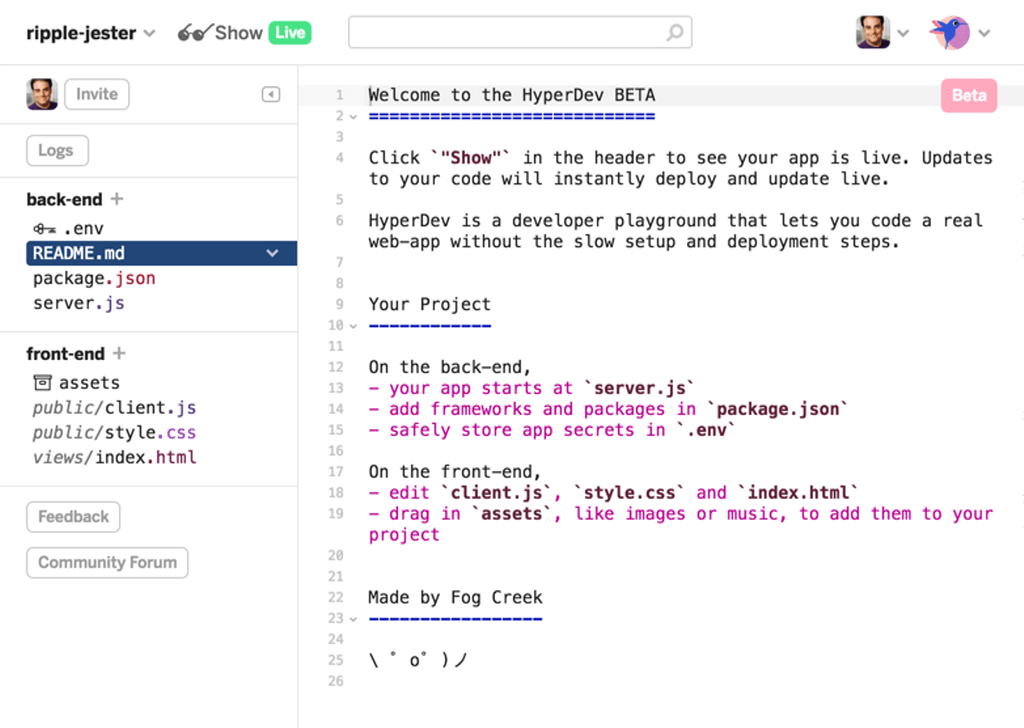
HyperDev is going to be the fastest way to bang out code and get it running on the internet. We want to eliminate 100% of the complicated administrative details around getting code up and running on a website. The best way to explain that is with a little tour.

Step one. You go to hyperdev.com.

Boom. Your new website is already running. You have your own private virtual machine (well, really it’s a container but you don’t have to care about that or know what that means) running on the internet at its own, custom URL which you can already give people and they can already go to it and see the simple code we started you out with.

All that happened just because you went to hyperdev.com.

Notice what you DIDN’T do.

  • You didn’t make an account.
  • You didn’t use Git. Or any version control, really.
  • You didn’t deal with name servers.
  • You didn’t sign up with a hosting provider.
  • You didn’t provision a server.
  • You didn’t install an operating system or a LAMP stack or Node or operating systems or anything.
  • You didn’t configure the server.
  • You didn’t figure out how to integrate and deploy your code.

You just went to hyperdev.com. Try it now!

What do you see in your browser?

Well, you’re seeing a basic IDE. There’s a little button that says SHOW and when you click on that, another browser window opens up showing you your website as it appears to the world. Notice that we invented a unique name for you.

Over there in the IDE, in the bottom left, you see some client side files. One of them is called index.html. You know what to do, right? Click on index.html and make a couple of changes to the text.

Now here’s something that is already a little bit magic… As you type changes into the IDE, without saving, those changes are deploying to your new web server and we’re refreshing the web browser for you, so those changes are appearing almost instantly, both in your browser and for anyone else on the internet visiting your URL.

Again, notice what you DIDN’T do:

  • You didn’t hit a “save” button.
  • You didn’t commit to Git.
  • You didn’t push.
  • You didn’t run a deployment script.
  • You didn’t restart the web server.
  • You didn’t refresh the page on your web browser.

You just typed some changes and BOOM they appeared.

OK, so far so good. That’s a little bit like jsFiddle or Stack Overflow snippets, right? NBD.

But let’s look around the IDE some more. In the top left, you see some server side files. These are actual code that actually runs on the actual (virtual) server that we’re running for you. It’s running node. If you go into the server.js file you see a bunch of JavaScript. Now change something there, and watch your window over on the right.

Magic again… the changes you are making to the server-side Javascript code are already deployed and they’re already showing up live in the web browser you’re pointing at your URL.

Literally every change you make is instantly saved, uploaded to the server, the server is restarted with the new code, and your browser is refreshed, all within half a second. So now your server-side code changes are instantly deployed, and once again, notice that you didn’t:

  • Save
  • Do Git incantations
  • Deploy
  • Buy and configure a continuous integration solution
  • Restart anything
  • Send any SIGHUPs

You just changed the code and it was already reflected on the live server.

Now you’re starting to get the idea of HyperDev. It’s just a SUPER FAST way to get running code up on the internet without dealing with any administrative headaches that are not related to your code.

Ok, now I think I know the next question you’re going to ask me.

“Wait a minute,” you’re going to ask. “If I’m not using Git, is this a single-developer solution?”

No. There’s an Invite button in the top left. You can use that to get a link that you give your friends. When they go to that link, they’ll be editing, live, with you, in the same documents. It’s a magical kind of team programming where everything shows up instantly, like Trello, or Google Docs. It is a magical thing to collaborate with a team of two or three or four people banging away on different parts of the code at the same time without a source control system. It’s remarkably productive; you can dive in and help each other or you can each work on different parts of the code.

“This doesn’t make sense. How is the code not permanently broken? You can’t just sync all our changes continuously!”

You’d be surprised just how well it does work, for most small teams and most simple programming projects. Listen, this is not the future of all software development. Professional software development teams will continue to use professional, robust tools like Git and that’s great. But it’s surprising how just having continuous merging and reliable Undo solves the “version control” problem for all kinds of simple coding problems. And it really does create an insanely addictive form of collaboration that supercharges your team productivity.

“What if I literally type ‘DELETE * FROM USERS’ on my way to typing ‘WHERE id=9283’, do I lose all my user data?”

Erm… yes. Don’t do that. This doesn’t come up that often, to be honest, and we’re going to add the world’s simplest “branch” feature so that optionally you can have a “dev” and “live” branch, but for now, yeah, you’d be surprised at how well this works in practice even though in theory it sounds terrifying.

“Does it have to be JavaScript?”

Right now the server we gave you is running Node so today it has to be JavaScript. We’ll add other languages soon.

“What can I do with my server?”

Anything you can do in Node. You can add any package you want just by editing package.json. So literally any working JavaScript you want to cut and paste from Stack Overflow is going to work fine.

“Is my server always up?”

If you don’t use it for a while, we’ll put your server to sleep, but it will never take more than a few seconds to restart. But yes for all intents and purposes, you can treat it like a reasonably reliably, 24/7 web server. This is still a beta so don’t ask me how many 9’s. You can have all the 8’s you want.

“Why would I trust my website to you? What if you go out of business?”

There’s nothing special about the container we gave you; it’s a generic VM running Node. There’s nothing special about the way we told you to write code; we do not give you special frameworks or libraries that will lock you in. Download your source code and host it anywhere and you’re back in business.

“How are you going to make money off of this?”

Aaaaaah! why do you care!

But seriously, the current plan is to have a free version for public / open source code you don’t mind sharing with the world. If you want private code, much like private repos, there will eventually be paid plans, and we’ll have corporate and enterprise versions. For now it’s all just a beta so don’t worry too much about that!

“What is the point of this Joel?”

As developers we have fantastic sets of amazing tools for building, creating, managing, testing, and deploying our source code. They’re powerful and can do anything you might need. But they’re usually too complex and too complicated for very simple projects. Useful little bits of code never get written because you dread the administration of setting up a new dev environment, source code repo, and server. New programmers and students are overwhelmed by the complexity of distributed version control when they’re still learning to write a while loop. Apps that might solve real problems never get written because of the friction of getting started.

Our theory here is that HyperDev can remove all the barriers to getting started and building useful things, and more great things will get built.

“What now?”

Really? Just go to HyperDev and start playing!

Stack Exchange Raises $40m

Today Stack Exchange is pleased to announce that we have raised $40 million, mostly from Andreessen Horowitz.

Everybody wants to know what we’re going to do with all that money. First of all, of course we’re going to gold-plate the Aeron chairs in the office. Then we’re going to upgrade the game room, and we’re already sending lox platters to our highest-rep users.

But I’ll get into that in a minute. First, let me catch everyone up on what’s happening at Stack Exchange.

In 2008, Jeff Atwood and I set out to fix a problem for programmers. At the time, getting answers to programming questions online was super annoying. The answers that we needed were hidden behind paywalls, or buried in thousands of pages of stale forums.

So we built Stack Overflow with a single-minded, compulsive, fanatical obsession with serving programmers with a better Q&A site.

Everything about how Stack Overflow works today was designed to make programmers’ jobs easier. We let members vote up answers, so we can show you the best answer first. We don’t allow opinionated questions, because they descend into flame wars that don’t help people who need an answer right now. We have scrupulously avoided any commercialization of our editorial content, because we want to have a site that programmers can trust.

Heck, we don’t even allow animated ads, even though they are totally standard on every other site on the Internet, because it would be disrespectful to programmers to strain their delicate eyes with a dancing monkey, and we can’t serve them 100% if we are distracting them with a monkey. That would only be serving them 98%. And we’re OBSESSED, so 98% is like, we might as well close this all down and go drive taxis in Las Vegas.

Anyway, it worked! Entirely thanks to you. An insane number of developers stepped up to pass on their knowledge and help others. Stack Overflow quickly grew into the largest, most trusted repository of programming knowledge in the world.

Quickly, Jeff and I discovered that serving programmers required more than just code-related questions, so we built Server Fault and Super User. And when that still didn’t satisfy your needs, we set up Stack Exchange so the community could create sites on new topics. Now when a programmer has to set up a server, or a PC, or a database, or Ubuntu, or an iPhone, they have a place to go to ask those questions that are full of the people who can actually help them do it.

But you know how programmers are. They “have babies.”  Or “take pictures of babies.” So our users started building Stack Exchange sites on unrelated topics, like parenting and photography, because the programmers we were serving expected—nay, demanded!—a place as awesome as Stack Overflow to ask about baby feeding schedules and f-stops and whatnot.

And we did such a good job of serving programmers that a few smart non-programmers looked at us and said, “Behold! I want that!” and we thought, hey!  What works for developers should work for a lot of other people, too, as long as they’re willing to think like developers, which is the best way to think. So, we decided that anybody who wants to get with the program is welcome to join in our plan. And these sites serve their own communities of, you know, bicycle mechanics, or what have you, and make the world safer for the Programmer Way Of Thinking and thus serve programmers by serving bicycle mechanics.

In the five years since then, our users have built 133 communities. Stack Overflow is still the biggest. It reminds me of those medieval maps of the ancient world. The kind that shows a big bustling city (Jerusalem) smack dab in the middle, with a few smaller settlements around the periphery. (Please imagine Gregorian chamber music).


View of Jerusalem
Stack Overflow is the big city in the middle. Because the programmer-city worked so well, people wanted to ask questions about other subjects, so we let them build other Q&A villages in the catchment area of the programmer-city. Some of these Q&A villages became cities of their own. The math cities barely even have any programmers and they speak their own weird language. They are math-Jerusalem. They makes us very proud. Even though they don’t directly serve programmers, we love them and they bring a little tear to our eyes, like the other little villages, and they’re certainly making the Internet—and the world—better, so we’re devoted to them.

One of these days some of those villages will be big cities, so we’re committed to keeping them clean, and pulling the weeds, and helping them grow.

But let’s go back to programmer Jerusalem, which—as you might expect—is full of devs milling about, building the ENTIRE FUTURE of the HUMAN RACE, because, after all, software is eating the world and writing software is just writing a script for how the future will play out.

So given the importance of software and programmers, you might think they all had wonderful, satisfying jobs that they love.

But sadly, we saw that was not universal. Programmers often have crappy jobs, and their bosses often poke them with sharp sticks. They are underpaid, and they aren’t learning things, and they are sometimes overqualified, and sometimes underqualified. So we decided we could actually make all the programmers happier if we could move them into better jobs.

That’s why we built Stack Overflow Careers. This was the first site that was built for developers, not recruiters. We banned the scourge of contingency recruiters (even if they have big bank accounts and are just LINING UP at the Zion Gate trying to get into our city to feed on programmer meat, but, to hell with them). We are SERVING PROGRAMMERS, not spammers. Bye Felicia.

Which brings us to 2015.

The sites are still growing like crazy. By our measurements, the Stack Exchange network is already in the top 50 of all US websites, ranked by number of unique visitors, with traffic still growing at 25% annually. The company itself has passed 200 employees worldwide, with big plush offices in Denver, New York, and London, and dozens of amazing people who work from the comfort of their own homes. (By the way, if 200 people seems like a lot, keep in mind that more than half of them are working on Stack Overflow Careers).

We could just slow down our insane hiring pace and get profitable right now, but it would mean foregoing some of the investments that let us help more developers. To be honest, we literally can’t keep up with the features we want to build for our users. The code is not done yet—we’re dedicating a lot of resources to the core Q&A engine. This year we’ll work on improving the experience for both new users and highly experienced users.

And let’s not forget Stack Overflow Careers. I believe it is, bar-none, the single best job board for developer candidates, which should  automatically make it the best place for employers to find developer talent. There’s a LOT more to be done to serve developers here and we’re just getting warmed up.

So that’s why we took this new investment of $40m.

We’re ecstatic to have Andreessen Horowitz on board. The partners there believe in our idea of programmers taking over (it was Marc Andreessen who coined the phrase “Software is eating the world”). Chris Dixon has been a personal investor in the company since the beginning and has always known we’d be the obvious winner in the Q&A category, and will be joining our board of directors as an observer.

This is not the first time we’ve raised money; we’re proud to have previously taken investments from Union Square Ventures, Index Ventures, Spark Capital, and Bezos Expeditions. We only take outside money when we are 100% confident that the investors share our philosophy completely and after our lawyers have done a ruthless (sorry, investors) job of maintaining control so that it is literally impossible for anyone to mess up our vision of fanatically serving the people who use our site, and continuing to make the Internet a better place to get expert answers to your questions.

For those of you who have been with us since the early days of Our Incredible Journey, thank you. For those of you who are new, welcome. And if you want to learn more, check out our hott new “about” page. Or ask!

How Trello is different

Just a few months ago, we launched Trello, a super simple, web-based team coordination system. The feedback has been overwhelmingly positive and adoption has been very strong, even in its early, 1.0 state.

Trello is new kind of development project for Fog Creek. It’s 100% hosted; there will never be an “installed software” version of Trello. That allowed us to modernize many aspects of our development process; I am happy to announce that there is absolutely no Visual Basic code involved in any part of Trello. What’s next, flying cars?

The biggest difference you’ll notice (compared to our previous products pitched solely at software developers) is that Trello is a totally horizontal product.

Horizontal means that it can be used by people from all walks of life. Word processors and web browsers are horizontal. The software your dentist uses to torture you with drills is vertical.

Vertical software is much easier to pull off and make money with, and it’s a good choice for your first startup. Here are two key reasons:

  • It’s easier to find customers. If you make dentist software, you know which conventions to go to and which magazines to advertise in. All you have to do is find dentists.
  • The margins are better. Your users are professionals at work and it makes sense for them to give you money if you can solve their problems.

Making a major horizontal product that’s useful in any walk of life is almost impossible to pull off. You can’t charge very much, because you’re competing with other horizontal products that can amortize their development costs across a huge number of users. It’s high risk, high reward: not suitable for a young bootstrapped startup, but not a bad idea for a second or third product from a mature and stable company like Fog Creek.

Forgive me if I now divert into telling you a quick story about my time spent on the Microsoft Excel team way back in 1991. (Yes, I know you were not born yet, but I assure you that computers had been invented. Just hop up here on my knee and shut up.)

Everybody thought of Excel as a financial modeling application. It was used for creating calculation models with formulas and stuff. You would put in your assumptions and then calculate things like “if interest rates go up by 0.00001% next year, what percentage of Las Vegas homeowners will plunge into bankruptcy?” For example.

Round about 1993 a couple of us went on customer visits to see how people were using Excel.

We found a fellow whose entire job consisted of maintaining the “number of injuries this week” spreadsheet for a large, highly-regulated utility.

Once a week, he opened an Excel spreadsheet which listed ten facilities, containing the name of the facilities and the number 0, which indicated that were 0 injuries that week. (They never had injuries).

He typed the current date in the top of the spreadsheet, printed a copy, put it in a three-ring binder, and that was pretty much his whole, entire job. It was kind of sad. He took two lunch breaks a day. I would too, if that was my whole job.

Over the next two weeks we visited dozens of Excel customers, and did not see anyone using Excel to actually perform what you would call “calculations.” Almost all of them were using Excel because it was a convenient way to create a table.

(Irrelevant sidenote: the few customers we could find who were doing calculations were banks, devising explosive devices called “derivatives.” They used Excel to maximize the bankers’ bonuses on nine out of ten years, and to cause western civilization to nearly collapse every tenth year. Something about black swans. Probably just a floating point rounding error.)

What was I talking about? Oh yeah… most people just used Excel to make lists. Suddenly we understood why Lotus Improv, which was this fancy futuristic spreadsheet that was going to make Excel obsolete, had failed completely: because it was great at calculations, but terrible at creating tables, and everyone was using Excel for tables, not calculations.

Bing! A light went off in my head.

The great horizontal killer applications are actually just fancy data structures.

Spreadsheets are not just tools for doing “what-if” analysis. They provide a specific data structure: a table. Most Excel users never enter a formula. They use Excel when they need a table. The gridlines are the most important feature of Excel, not recalc.

Word processors are not just tools for writing books, reports, and letters. They provide a specific data structure: lines of text which automatically wrap and split into pages.

PowerPoint is not just a tool for making boring meetings. It provides a specific data structure: an array of full-screen images. 

Some people saw Trello and said, “oh, it’s Kanban boards. For developing software the agile way.” Yeah, it’s that, but it’s also for planning a wedding, for making a list of potential vacation spots to share with your family, for keeping track of applicants to open job positions, and for a billion other things. In fact Trello is for anything where you want to maintain a list of lists with a group of people.

There are millions of things that need that kind of data structure, and there hasn’t been a great “list-of-list” app before Trello. (There have been outliners, but outlines are, IMHO, one of the great dead ends in UI design: so appealing to programmers, yet so useless to civilians).

Once you get into Trello, you’ll use it for everything. I use about thirty Trello boards regularly, and I use them with everyone in my life, from the APs (Aged Parents), with whom I plan vacations, with every team at work, and just about every project I’m involved in.

So, ok, that was the first big difference with Trello: horizonal, not vertical. But there are a bunch of other differences:

It’s delivered continuously. Rather than having major and minor releases, we pretty much just continuously push out new features from development to customers. A feature that you built and tested, but didn’t deliver yet because you’re waiting for the next major release, becomes inventory. Inventory is dead weight: money you spent that’s just wasting away without earning you anything. Sure, 100 years ago, we had these things called “CD-ROMs” and we shipped software that way, so there was an economic reason to bunch up features before we inflict ‘em on the world. But there’s no reason to work that way any more. You already knew that, of course. I’m just saying—I stopped using Visual Basic about five minutes ago. Brave New World.

It’s not exhaustively tested before being released. We thought we could get away with this because Trello is free, so customers are more forgiving. But to tell the truth, the real reason we get away with it is because bugs are fixed in a matter of hours, not months, so the net number of “bugs experienced by the public” is low.

We work in public. The rule on the Trello team is “default public.” We have a public Trello board that shows everything that we’re working on and where it’s up to. We use this to let customers vote and comment on their favorite features. By the way, while Trello was under development, it was secret. We had a lot of beta testers who gave us customer feedback so that the development team could use lean startup principles, but the nine months we spent building version 1.0 in secret gave us a significant lead in a competitive marketplace. But now that we’re shipping, there’s no reason not to talk about our plans.

This is a “Get Big Fast” product, not a “Ben and Jerry’s”  product. See Strategy Letter I. The business goal for Trello is to ultimately get to 100 million users. That means that our highest priority is removing any obstacles to adoption. Anything that people might use as a reason not to use Trello has to be found and eliminated. For example:

Trello is free. The friction caused by charging for a product is the biggest impediment to massive growth. In the long run, we think it’s much easier to figure out how to extract a small amount of money out of a large number of users than to extract a large amount of money out of a small number of users. Once you have 100 million users, it’s easy to figure out which of those users are getting the most value out of the product you built. The ones who are getting the most value will be happy to pay you. The others don’t cost much to support.

The API and plug-in architectures are the highest priority. Another way of putting that is:  never build anything in-house if you can expose a basic API and get those high-value users (the ones who are getting the most value out of the platform) to build it for you. On the Trello team, any feature that can be provided by a plug-in must be provided by a plug-in.

(The API is currently in very rudimentary form. You can already use it to do very interesting things. It is under rapid development.)

We use cutting edge technology. Often, this means we get cut fingers. Our developers bleed all over MongoDB, WebSockets, CoffeeScript and Node. But at least they’re having fun. And in today’s tight job market, great programmers have a lot of sway on what they’re going to be working on. If you can give them an exciting product that will touch millions of people, and let them dig deep into TCP-IP internals while they try to figure out why simple things aren’t working, they’ll have fun and they’ll love their jobs. Besides, we’re creating a product that we’ll be working on for the next ten years. Technology that’s merely “state of the art” today is going to be old and creaky in five years. We tried to go a little bit beyond “state of the art.” It’s a calculated risk.

None of this is very radical. TL;DR: Fog Creek Software develops an internet product using techniques that every Y-combinator startup has been using since spez was sleeping with his laptop so he could reboot Reddit when Lisp crashed in the middle of the night. If you haven’t tried Trello yet, try it, then tell me on twitter if it worked.

Careers 2.0 (by Stack Overflow)

One day, you’ll be telling your grandchildren about getting a programming job, version 1.0. You would send a “resume” to a “recruiter.” It included all kinds of silly information required by the esoteric resume ritual (foreign languages spoken, whether or not you play ultimate Frisbee, Microsoft-veteran status). This so-called “information” was utterly useless at determining whether you could program or not, but if you spelled everything right and used suitable fonts, you could come in for a day of interviews at which you would be asked to perform mundane programming tasks on a whiteboard.

Careers 2.0 is here!